I decide I need a better camera

img_3032.jpg

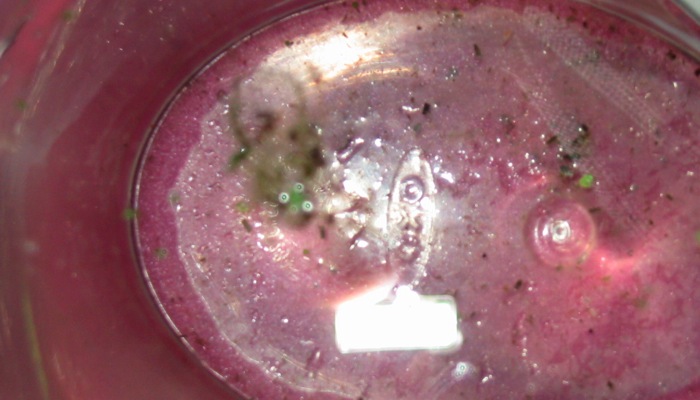
One of the females’ eggs have been hatching, a few a day, for several days.  Today, at last, all the rest hatched in a lump.  I returned both grown-ups to their home, strained the contents of the bowl through a fine-mesh net and rinsed the net out into a cup of fresh water, pictured above.  (Can you see the zoes in the water?  I can’t.  There are some microscopic close-ups below.)


Then I divided the larvae among the three tanks.  I’d guess there are around 100 per tank, but it’s very hard to tell.


Anyway, now that the salt-water tanks are populated, it’s time for me to go on vacation.


20070617_130249737.png20070617_124759802.png

Posted in critters | Leave a comment

Verdure

Now, a month later, those three tanks look like this:

img_3030.jpg

So, we know I can grow algae.


By this time, I’ve uncovered a few inconsistencies in my experiment.  It turns out that light is emitted from a bulb in diagonal directions as well as straight down (no big surprise there)  so the middle tank gets considerably more light than those on the ends.  This was more obvious at the beginning of May, when the middle tank was a nice dark green but the other two had barely gotten started.  I’m hoping that from a zoe’s point of view the food-supply is near infinite in all three tanks, but there may be differences in growth rate.  (A store that sells frozen Tetraselmis claims better growth rate with frozen algae over live algae because less energy is spent in foraging.  A difference in food density may change the growth rate for similar reasons.)


The other inconsistency is that the middle heated tank is a degree or so warmer than the rightmost.  That’s due to laziness — I’m tired of fussing with the thermostat and I can’t get things quite right.


On account of the warm spring, the leftmost tank is warmer than I’d planned, nearly 70 degrees.  I’m most interested in whether or not growth is stopped altogether by winter temperatures in the 50’s, but I’ll have to wait until winter to learn about that.


Meanwhile, the eggs look close to hatching.  By this time nearly all of the females are carrying eggs, so it’s hard to know which one had them first — this means that I won’t know exactly how long egg development takes, although it seems to be following the expect 5-week course.


I’ve moved a couple of especially eggy females into a bowl where I can more easily collect the larvae when they hatch.


img_3026.jpg

img_2724.jpg

Posted in critters | Leave a comment

Grand-eggs

img_3033.jpg

img_3018.jpg

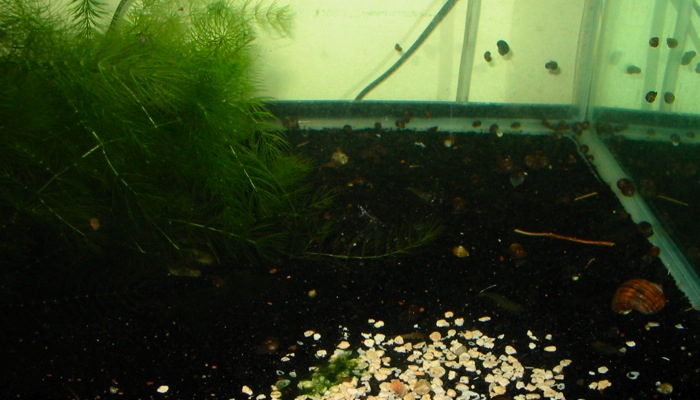
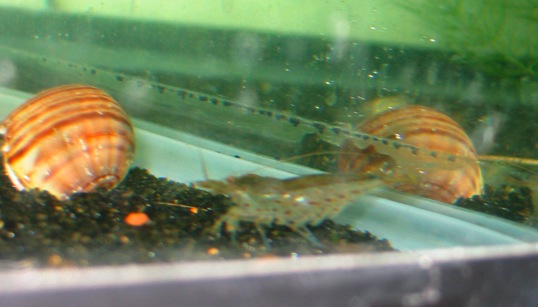
Today, these formerly tiny shrimp (hatched on Oct. 7 2006, moved into seawater on Oct. 9, moved painstakingly back into freshwater in late November by Kim while I was off sitting on a beach someplace in SE Asia) seem to have grown up.  The first female laid eggs yesterday.


So, that answers one question — it seems to take about 6 months from hatch to parenthood.


I had a few sets of larvae die before these few survived, and I varied conditions quite a bit during the raising of this batch.  So, in order to learn what’s necessary and what isn’t, I’ve set up three similar tanks to raise the next set of zooaes.


 img_3009.jpg

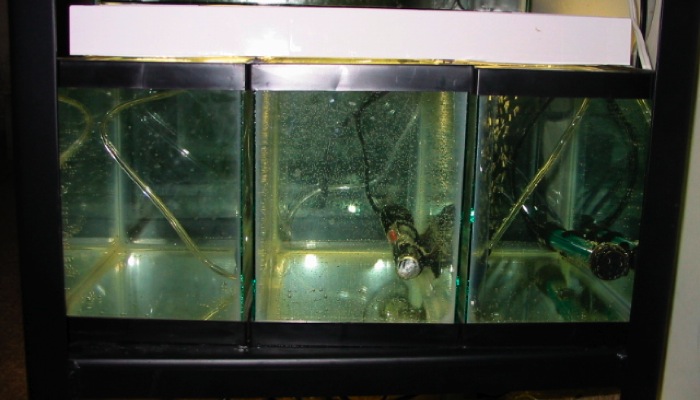
That’s three 10-liter tanks.  The rightmost tank is heated and aerated, the middle heated without aeration, and the leftmost aerated without heat.  The heated tanks are at about 80°F.  All three share a single 15-watt fluorescent light. Each is full of artificial sea-water, at around 35ppt, and seeded with a few CCs of Tetraselmis culture.

img_3012.jpg

And now, I wait.

Posted in critters | Leave a comment